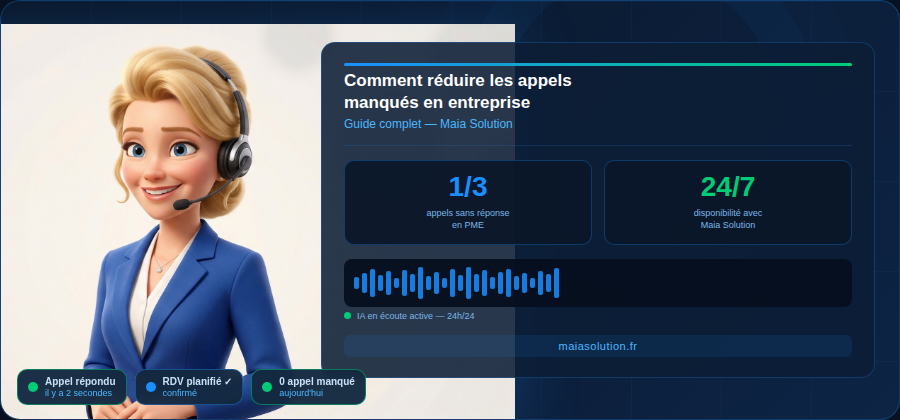
"Hello?" Two seconds were enough: the caller doesn't know if they dialed the right number, doesn't know who they're talking to, and feels like they're interrupting. Answering the phone is the very first commercial contact - before the quote, the appointment, the visit - and it often decides what happens next.
In this guide: the 7 rules of a professional phone greeting, 3 ready-to-use greeting scripts (retail, medical practice, tradesperson), the limits of human phone reception, and how an AI phone assistant applies these rules 24/7, without variation.
Why answering the phone is your first commercial contact
Within seconds, the caller assesses three things: am I in the right place, am I being taken seriously, will I get an answer? That first impression is almost never recovered: a disappointed customer doesn't complain - they simply call someone else.
What the numbers say
- 📵 According to telecom industry studies, 25 to 30% of inbound calls go unanswered in small businesses - far more at peak times
- 🔇 60 to 80% of callers who reach voicemail leave no message
- 🏃 An unanswered caller rarely calls back: they contact a competitor within minutes
- 📉 One bad first impression (waiting, curt tone, lost message) loses a customer before the first sale even happens
We quantified the cost of those lost calls in our guide on missed calls in business. Here, we focus on the other half of the problem: the quality of the answer when you do pick up.
The 7 rules of a professional phone greeting
Seven simple rules, independent of company size and budget - provided you stick to them on every single call.
⏱️1. Answer before the 3rd ring
👋2. The greeting formula: company + first name + hello
😊3. The tone: smile, steady pace, available voice
🔁4. Rephrase the request
📝5. Structured message-taking (5 elements)
📞6. A promised callback is a callback made
🌊7. Anticipate peak hours
3 ready-to-use phone greeting script examples
Three templates to adapt to your own vocabulary. The structure is always the same: identification, taking charge, rephrasing, action, closing.
Script #1 - Retail / shop
🛍️ Greeting script for a shop
Taking charge: "Of course, let me check right away. Which model is it for?"
Rephrasing: "So model [X] in size M - let me have a look, one moment."
If unavailable: "I don't have any left, but I can reserve one for you: it arrives Thursday. Shall I call you as soon as it's in?"
Closing: "Noted, Mrs. Martin: reserved in your name, we'll call you Thursday. Thanks for calling!"
Script #2 - Medical or paramedical practice
🩺 Greeting script for a medical practice
Identification: "Are you already a patient here? Under what name?"
Qualification: "Is it for a prescription renewal, a check-up, or an urgent matter?"
Proposal: "I can offer you Tuesday at 9:40 or Thursday at 4:15."
Confirmation: "Noted: Tuesday 9:40. Please bring your insurance card."
Safety net: "If your condition worsens before then, call us back or contact the emergency services."
Script #3 - Tradesperson / construction business
🔧 Greeting script for a tradesperson
Qualification: "Is it for an emergency repair or a renovation project?"
If repair: "Can you describe the problem? At what address? Since when?"
If quote: "Let me take your details. [First name] will call you back tonight between 5 and 7 p.m. to arrange a visit."
Closing: "To recap: leak under the sink, 12 Tanner Street, callback tonight. Thanks for calling!"
The limits of human phone reception (even excellent)
A well-trained team applies these rules… when it's available. The problem with human phone reception isn't competence: it's coverage. One person handles one call at a time, during working hours, with quality that varies with the workload of the moment.
- Breaks and meetings: the lunch break is often the peak calling time for private customers
- Holidays and sick leave: reception rests on one or two people - one absence and it all collapses
- Simultaneous calls: at peak times, the 2nd and 3rd calls ring into the void
- Evenings and weekends: out-of-hours calls frequently represent 20 to 30% of total volume
- Human variation: stress, fatigue, end of day - perfect consistency doesn't exist
| Situation | Human reception alone | With an AI assistant as backup |
|---|---|---|
| Call during the lunch break | Voicemail or unanswered ringing | Immediate answer, message taken or appointment booked |
| 3 simultaneous calls Monday at 9 a.m. | 1 call handled, 2 lost | All 3 calls handled in parallel |
| Call on Saturday at 7:30 p.m. | Postponed to Monday (if the caller calls back) | Immediate answer, 24/7 |
| Quality of the greeting formula | Varies with the person and the hour | Identical on every call |
Classic overflow solutions have their own limits: an in-house receptionist (a full salary, office hours), an outsourced answering service (billed per call, generic scripts - see our analysis of outsourced phone answering prices), or a touch-tone IVR that drives callers away (see IVR vs AI assistant).
How an AI assistant applies these rules 24/7, without variation
An AI phone assistant is not a touch-tone voice menu: it's a conversational AI that picks up instantly and follows your greeting instructions to the letter - nights, Sundays and holidays included.
The 7 rules, AI version
1. Instant pickup
2. Your greeting formula, exactly
3. A constant tone
4. Systematic rephrasing
5. Always-complete message-taking
6. No impossible promises
7. Peak hours absorbed
Concretely, how does it get set up?
At Maia Solution, the V1 of your agent is custom-built in about a week: greeting formula, vocabulary, message and callback instructions. You test it on a dedicated test number, we adjust it for free (V2, V3…) until you're satisfied, then it goes live on your real number.
Then comes the free trial: one week in real conditions on your real number, no credit card required. If you stop, we uninstall and nothing is billed; if you continue, the subscription starts the following week - monthly with no commitment or annual with a one-year commitment, from €79 to €300 (excl. VAT) per month plus €0.20 (excl. VAT) per call minute (details on the pricing page).
FAQ - Professional phone greeting
What is the best phone greeting phrase for a business?▼
The reference formula: "[Company name], [First name], good morning!" The caller knows they're in the right place and has an identified contact. You can add "…what can I do for you?" as long as the pace stays natural. To avoid: "Hello?", "Yes?" and an inaudible company name.
How many rings before answering?▼
The professional standard: answer before the 3rd ring, about 10 seconds. Beyond that, the abandonment rate climbs with every ring. If nobody can pick up, automatic forwarding to a backup solution (AI assistant, answering service) beats voicemail: 60 to 80% of callers leave no message there.
What should a phone message include?▼
Five elements, systematically: the caller's name, their company if any, a callback number, the precise reason for the call and the level of urgency - ideally completed with the best time slot to call back. An incomplete message ("Mr. Martin called") forces a re-qualification call and makes the customer feel unheard.
Can an AI assistant really deliver a professional phone greeting?▼
Yes, because professional reception is a matter of consistency: instant pickup, exact formula, rephrasing, complete message - the AI applies these rules on every call without variation, and always clearly introduces itself as an assistant. When a human is needed (sensitive complaint, negotiation), it transfers the call or takes a structured message. At Maia Solution you can verify it risk-free: V1 built in about a week, tested on a test number, adjusted for free until you're satisfied, then a one-week free trial on your real number, with no credit card.
Conclusion: a good greeting isn't a talent, it's a discipline
Pick up fast, introduce yourself clearly, rephrase, take complete messages, keep your callback promises: nothing complicated. The hard part is applying it on every call, all year long - including at 12:30 p.m., on Saturday evening and during the holidays.
That's where an AI phone assistant changes the game: it doesn't replace the human relationship that makes your value - it guarantees that the first contact is always up to standard, at any hour. Your team takes over where it contributes most.
What if no call ever went unanswered again?
Custom agent built in about a week, adjusted for free until you're satisfied. Then a one-week free trial on your real number, no credit card required.
Start my free trial