You're a plumber, electrician, carpenter, mason, painter or roofer. The phone rings at 9 a.m. while you're under a sink. At 11 while you're pulling cable through a drop ceiling. At 2 p.m. while installing a boiler ten feet up. Every single time, you face the same impossible equation: pick up, or finish what you're doing.
And every time, you know exactly what it means. A missed call in construction trades isn't some abstract « lost opportunity ». It's 80 to 300 € of revenue walking straight to a competitor. In this article, we look concretely at how an AI phone assistant changes the game for a tradesperson - with no hardware to install, no phone number to change, and no hiring required.
The hidden cost of missed calls for a tradesperson
In France, more than 70 % of tradespeople and self-employed professionals admit to missing calls every day. In a sector where every inquiry can represent hundreds, even thousands of euros, that's a massive lost-revenue figure - and most of the time, completely invisible in your accounts.
Why tradespeople miss so many calls (even when reachable)
- 🔧 Hands occupied: under a car, in a drop ceiling, mid-weld. Picking up is physically impossible.
- 🏗️ Site noise: drill, hammer, grinder - even if you pick up, you can't hear a thing.
- 🚐 On the move: between two jobs, in the van, you let it ring planning to call back later. But the customer doesn't call back.
- 📵 Evenings and weekends: private customers look for a tradesperson Saturday at 6 p.m. You, you're recovering from your week.
How much does a missed call cost in the trades?
Depending on the trade, the average cost of a missed call for a tradesperson is estimated between 80 € and 300 € of lost revenue. Why such a wide range? Because a missed call can be:
- A quote request for €2,000 worth of work
- An emergency callout at €150 per intervention
- A customer follow-up for an €8,000 renovation
- A supplier wanting to confirm an order
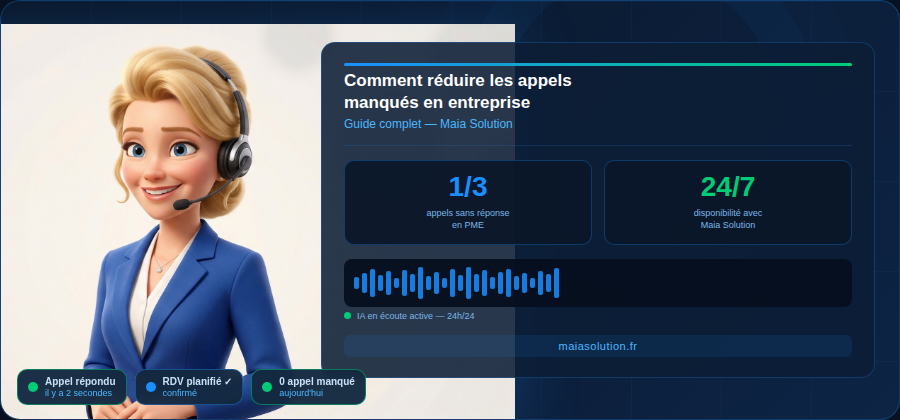
1 in 3 missed calls is a quote or appointment request. And the vast majority of callers hang up without leaving a voicemail - meaning you won't even know someone tried to reach you.
Why classic solutions don't work for a tradesperson
Before talking about AI, let's honestly review the solutions you may have already tried - and why they fall short in a tradesperson's daily life.
📞 The classic voicemail
👩 The spouse or partner answering calls
🏢 Outsourced answering service (call center)
🤖 Touch-tone voice menu (DTMF)
💼 Hiring a secretary
How a voice AI assistant actually handles a tradesperson's calls
An AI phone assistant is not a voicemail, not a touch-tone menu, not an outsourced operator. It's a conversational artificial intelligence that understands natural language, knows your trade, and can perform concrete tasks - such as booking an appointment or qualifying an emergency.
A typical call, step by step
1. Instant pickup, in your name
2. Identifying the request
3. Precise qualification of the need
4. Calendar slot suggestion
5. Smart emergency handling
6. Confirmation and call summary
What the AI can do beyond appointments
Beyond appointment booking, a well-configured AI phone assistant can:
- Give your base rates (call-out, travel, emergency repair) according to your rules
- Check whether the service area is covered (postcode)
- Filter out out-of-scope requests (sales solicitations, cold calls)
- Direct callers to your website or a form for complex quotes
- Answer frequent questions (opening hours, public holidays, payment methods)
5 concrete situations the AI handles every day
Rather than promises, here are typical examples from a tradesperson's day - and how the AI responds.
- 1.The customer at 8 a.m. with a leak. You're already on site. The AI takes the call, qualifies the urgency, offers a late-morning slot if feasible, or escalates to your number if it's truly critical.
- 2.The homeowner calling for a renovation quote. The AI asks the right questions (scope of work, surface area, postcode), takes contact details, and schedules a site visit according to your availability. You receive a full brief by email before the appointment.
- 3.The cold caller trying to sell you insurance. The AI detects the commercial context, politely ends the call, and doesn't waste a second of your time.
- 4.The customer calling back to reschedule. The AI recognizes the context, checks your calendar, offers a new slot, confirms it with the customer on the call, and updates your calendar. You receive the summary by email.
- 5.The supplier wanting to confirm a delivery. The AI takes the info, logs the message in your dashboard, and notifies you. You stay in control without being interrupted.
How much does it cost vs. other solutions
| Solution | Monthly cost | Availability |
|---|---|---|
| Hired secretary | €2,000 – 3,000 gross | 35 h / week |
| Outsourced answering service | €200 – 600 + per-minute | Office hours |
| Voicemail + manual callback | Free, but 5–10 h/week of your time | Delayed (3 % return rate) |
| AI phone assistant | From €79 / month (ex. VAT) | 24/7 |
In practice, an AI phone assistant costs 10 to 30 times less than a dedicated employee, and offers availability no human can match (nights, Sundays, public holidays included). For a sole trader or small team, it's often the best value on the market - especially given the revenue lost on every missed call.
Setup: what to plan for (and what we don't touch)
The good news: you have nothing to install at your premises, no hardware, no IT rollout. However, we need to fully understand your trade to configure a truly useful agent.
What we'll need from you
📞A phone setup of your choice
- Option A - A new Maia number: we assign you a dedicated number for your AI assistant.
- Option B - Keep your current number: you keep your usual number and configure an automatic call forwarding with your carrier (mobile or landline) to the AI number. Your customers see absolutely no difference.
🏗️Your business scope
📅Your calendar
🚨Your emergency rules
How long until I have my agent?
Roughly one week on average to deliver a turnkey agent tailored to your trade and the way you work. Why not faster? Because every agent is unique: your trade vocabulary, your services, your emergency rules, your service areas. This personalization is what makes the difference between a generic robot that annoys your customers and an assistant that feels like someone from your company.
During that week, you continue your activity as normal - no hardware to install, no work on your premises, no service interruption.
FAQ - The real questions tradespeople ask about voice AI
Will my customers realize they're talking to an AI?▼
The AI always introduces itself clearly as an automated assistant (this is a legal obligation). But the conversation is so fluent that the vast majority of customers are perfectly fine with it - especially when their call is picked up immediately instead of going to voicemail.
What if the customer reports a real emergency?▼
The AI detects emergencies according to your custom rules: keywords (« leak », « breakdown », « tripped »), described severity, context (heating in winter). It then immediately transfers the call to your mobile, or transfers it to the on-call phone you've designated (with, if you wish, a summary by email). You always stay in control of what counts as urgent.
Can I keep my current phone number?▼
Yes, two options. Either we assign you a new dedicated number for the AI assistant. Or you keep your usual number and configure an automatic call forwarding with your carrier (mobile or landline) to the AI number. Your customers keep dialing the same number - they see absolutely no difference.
Does the AI understand regional accents and dialects?▼
Yes. Modern voice recognition models handle regional accents, local expressions, and even background noise very well. If the AI doesn't understand a word, it politely asks: « Sorry, could you repeat that please? » - exactly like a human receptionist would.
Does the calendar integrate with my current tool?▼
Native integration with Google Calendar is operational. For other tools (Outlook, Apple Calendar, trade-specific software), we set up an adapted solution - via webhook if the tool allows it, or via an alternative workflow (notifications, email, shared file). Either way, you see your appointments in the tool you already use.
What about confidentiality? Does my customer data stay in Europe?▼
Maia Solution is GDPR-compliant, with EU-exclusive hosting. Sensitive data is encrypted with AES-256-GCM. No data leaves Europe - an important point if you want to avoid the implications of the US Cloud Act.
Can I try before I commit?▼
Yes, MAIA Solution offers a free trial, no credit card required. You see real calls flowing through your dashboard, you assess the quality of the appointment-taking, and you decide based on facts. And even after, you remain commitment-free - cancellable any time.
Conclusion: your real skill is on the job - not on the phone
A tradesperson's value lies in their hands, expertise, craftsmanship. Not in their ability to pick up between two screws. Yet it's precisely the missed phone that drives your customers to the competition - while you're doing your job well.
An AI phone assistant isn't a tech fad. It's a concrete, affordable tool that solves a universal problem in the trades: capturing every business opportunity without having to choose between your work and your phone. And for sole traders or small teams who can't afford a secretary, it's now the only solution that ticks every box: 24/7 availability, accessible pricing, GDPR compliance, and zero-hardware installation.
Want to try it on your business?
Free trial without credit card. Custom agent delivered in a week. No commitment, cancellable any time.
Start my free trial