Tuesday, 10:45 a.m. You're in a client meeting, your colleague is on the phone with a supplier, and the main line rings unanswered. On the other end, a prospect had one simple question before signing. They didn't leave a message. They called... the next competitor on Google. A missed call is almost never a customer who calls back: it's most often a customer who calls someone else.
Tradesperson, professional practice, shop, small business or service SME: the problem of missed business calls is the same everywhere - only the amounts change. In this guide, we quantify the real scale of the phenomenon, identify the causes, and above all compare the 4 concrete solutions - hiring, outsourced phone answering, IVR, AI phone assistant - on cost and effectiveness, with a 4-step method so you never lose anything again.
Missed business calls: the (quantified) scale of the problem
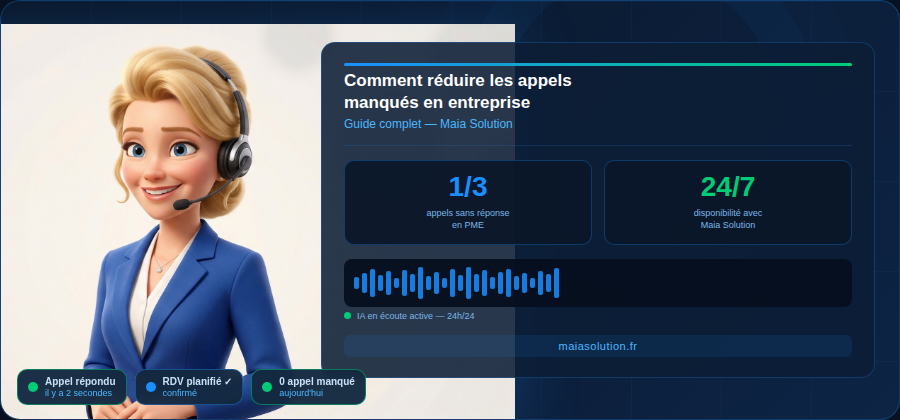
Let's start with a reality few business owners measure precisely: according to telecom industry studies, between 25 and 30 % of inbound calls go unanswered in small and medium businesses. During peak hours or holiday periods, that rate can climb to nearly one call in two. And most companies have no idea, simply because nobody counts the calls that never connected.
The caller's reflex: they don't call back, they call elsewhere
The second figure matters even more than the first: 60 to 80 % of callers who reach a voicemail or an unanswered ring leave no message at all. And among them, most never make a second attempt: they go back to their Google search, their list of recommendations or the directory, and dial the next number. For a new prospect, your business often gets only one chance to pick up.
What a missed call costs depending on your industry
- 🔧 Construction tradesperson: a call usually means a quote request. Job value: from €300 (emergency repair) to several thousand euros (renovation)
- ⚖️ Professional practice (lawyer, accountant, practitioner): a €50–250 consultation, and sometimes the start of a client relationship lasting years
- 🍽️ Restaurant, salon, shop: a booking or appointment worth €30–80 average ticket, going straight to the business next door
- 🏢 B2B service SME: an inbound lead can represent a contract worth several thousand euros a year
And this calculation remains conservative: it counts neither existing customers annoyed at never reaching you (who eventually leave), nor the impact on your reputation - « impossible to get them on the phone » is one of the most frequent complaints in small businesses' Google reviews.
Why your business misses calls (and why it's not a lack of effort)
Nobody lets a phone ring out of carelessness. If you're missing calls, it's almost always for one of these five structural reasons - and none of them gets fixed by « paying more attention ».
The 5 classic causes of missed calls
⏰1. Peak hours: everyone calls at the same time
🛠️2. You're busy doing your actual job
🍽️3. Lunch breaks, evenings and weekends
🏖️4. Holidays, sick leave, understaffing
📞5. One line, one call at a time
Never miss a call again: the 4 solutions compared on cost and effectiveness
Four families of solutions exist to answer all your calls. None is bad in itself - but they differ widely in cost, coverage hours, and quality of experience for the caller.
👩💼1. Hiring a receptionist or assistant
The historical solution: a dedicated person handling phone reception, who knows the company and can take on extra tasks (mail, invoicing, scheduling).
The cost: around €2,200 per month fully loaded for a full-time minimum-wage position - significantly more for an experienced profile. The limits: 35 hours a week (about 20 % of the 168 hours in a week), holidays and sick leave to cover, and still only one call at a time. Relevant if your call volume justifies a full position and the person has other value-added duties.
🏢2. Outsourced phone answering service
Shared operators answer in your name following a script, take messages and sometimes book appointments.
The cost: typically €1 to €3 per handled call, i.e. €80 to €600 per month depending on volume - a bill that climbs fast if your business takes off. The limits: coverage mostly limited to office hours, operators juggling dozens of clients, superficial knowledge of your business (« I'll take your details, someone will call you back »), and variable quality at peak hours... which are the same for all their clients.
🤖3. Touch-tone IVR (« Press 1, press 2 »)
The interactive voice response system always answers, true - but it handles nothing. It routes, puts on hold, and frustrates.
The cost: low, often €20 to €100 per month. The limits: a significant share of callers hang up before the end of the menu, the IVR takes neither appointments nor structured messages, and the image it projects (« your call is important to us... ») is exactly what a small business wants to avoid. Technically, the call is answered; commercially, it's often lost anyway.
✨4. The AI phone assistant
A conversational artificial intelligence answers in natural language, understands the request, provides information, books appointments and takes structured messages - configured specifically for your business.
The cost: from €79 (excl. VAT) per month, with no recruitment and no hardware. The strengths: available 24/7, handles several simultaneous calls with no queue, takes no holidays or breaks, transfers sensitive cases to your mobile, and logs every call in a dashboard. The honest limit: it takes about a week of setup to truly know your business, and some complex cases will still need a human transfer.
| Solution | Monthly cost | Availability |
|---|---|---|
| Salaried receptionist | ≈ €2,200 fully loaded (full-time minimum wage) | 35 h / week, excluding holidays and absences |
| Outsourced answering service | €1 – 3 / call (€80 – 600) | Mostly office hours |
| Touch-tone IVR | €20 – 100 | 24/7, but high abandonment rate |
| AI phone assistant | From €79 (excl. VAT) / month | 24/7, simultaneous calls |
The right question isn't « which solution is the cheapest? » but « how much does each recovered call bring me? ». At €250 average value per opportunity, recovering a single missed call per month pays for a €79 AI assistant. A €2,200 receptionist needs to recover nine - only during their working hours.
The 4-step method to stop losing anything
Whatever solution you choose, the winning approach is the same. Here is the method we apply with businesses that want to move from a 70 % answer rate to nearly 100 %.
The 4 steps
📊Step 1 - Measure your reality for 2 weeks
🗺️Step 2 - Map your critical moments and call reasons
⚙️Step 3 - Set up a 24/7 safety net, without changing your number
📈Step 4 - Track your numbers and adjust every month
The good news: this project doesn't take months. From the initial measurement to an operational safety net, count three to four weeks - and the effect is visible from the very first week of operation, particularly on lunch and evening slots.
FAQ - Your questions about missed calls
Isn't a simple voicemail enough?▼
No, and the figures are stubborn: 60 to 80 % of callers leave no message on a voicemail, and a large share of those who hang up call a competitor right after. Voicemail is a net full of holes: it captures a minority of calls, with delay, and then forces you into a callback session - often in the evening, often unsuccessfully (the caller doesn't pick up a number they don't recognize). Voicemail remains useful as a last-resort backup, but it is not a solution to the missed-call problem: it's more like its symptom.
How does conditional call forwarding work in practice?▼
It's a feature included by virtually all carriers and VoIP providers. You define a rule: if the line is busy, or if nobody answers after X rings, or permanently on certain time slots, the call is automatically redirected to another number - your AI assistant's or your answering service's. Your customers always dial the same number and notice no difference. Setup takes a few minutes from your carrier's customer portal, and it's reversible at any time. It's the simplest way to never miss calls again without changing anything in your existing setup.
Can an AI assistant really take reliable appointments and messages?▼
Yes, provided it's configured seriously. A modern AI phone assistant understands natural language (no « press 1 »), checks your availability in real time, suggests slots, saves the appointment in your calendar and sends an immediate summary by email. For messages, it systematically collects the key information: name, number, reason for calling, urgency level, and any data specific to your trade (job-site address, file reference, symptoms...). Every call is transcribed and available in your dashboard. Reliability comes from personalization: an agent custom-configured for your business, your services and your rules makes the difference between a gimmick and a true phone colleague.
Will my customers accept talking to an AI?▼
The assistant always introduces itself clearly as an automated assistant at the start of the call - essential transparency. But look at it from the caller's perspective: what do they prefer between an unanswered ring, an impersonal voicemail, 4 minutes of hold music... and an instant, polite answer that understands their request, gives them the information they need or books them a slot in two minutes? Experience shows that what matters to the caller is getting an immediate answer and a concrete result. And for sensitive situations (complaint, emergency, complex file), the AI transfers the call to your mobile or takes a priority message - it doesn't replace humans where humans are essential.
How long does it take to set up an AI phone assistant?▼
Count about one week for a complete setup: understanding your business, configuring the agent (your services, your hours, your tone, your transfer rules), testing on a dedicated number, adjustments, then going live via call forwarding. No hardware to install, no mandatory number change. At Maia Solution, you first test the assistant on a trial number with a free trial, no credit card required: you watch simulated calls flow into your dashboard and we adjust everything for free before the real go-live. The subscription then remains commitment-free, cancellable at any time.
Conclusion: the problem isn't your team, it's the missing safety net
A business that misses 25 % of its calls doesn't lack professionalism - it lacks architecture. As long as phone answering relies solely on the availability of humans who (fortunately) have a job to do, breaks and holidays, part of the calls will fall into the void, and with them customers who will never reach out a second time.
The solution fits in one sentence: measure what you're losing, then install a safety net available 24/7 - at the best cost-effectiveness ratio. In 2026, an AI phone assistant from €79 a month does this job better than an IVR, with broader coverage than an outsourced answering service, and 27 times cheaper than hiring. All without changing your number, while letting your team focus on what it does best: its job.
Want to know how many calls you'd recover?
Free trial, no credit card required. Custom agent delivered in one week. No commitment, cancel anytime.
Start my free trial